 World of Warcraft

At the southern edge of Kalimdor, where desert winds carry both silence and memory, lies the ancient land of Uldum, a region shaped not only by time, but by design. Unlike the wild terrains that define much of Azeroth, Uldum exists as a deliberate creation, a place where the will of the titans once took form in stone, sand, and hidden machinery. Its dunes and sunlit ruins hide a purpose far greater than survival or settlement, for beneath its surface rests a power capable of reshaping the world itself. To approach Uldum is to step into a landscape where history is layered with intention, and where every ruin, every shifting grain of sand, speaks of vigilance, secrecy, and the enduring weight of cosmic design.
A Constructed Wilderness
Uldum’s identity is inseparable from its origins as a titan research facility, a place forged during the ordering of Azeroth to refine and stabilize the world’s newly forming shape. Though now dominated by desert, this was not always the case. In its earliest era, Uldum flourished as a lush expanse of jungles and waterways, and its transformation into an arid wasteland was the result of a single, catastrophic decision tied to the immense power it was built to contain.
At the heart of this design stands the Forge of Origination, an instrument of immense purpose. Intended to regulate the world’s systems and safeguard its integrity, it was also imbued with a final, devastating function: the ability to reoriginate Azeroth entirely, erasing all life should the corruption within prove irreversible. This duality defines Uldum, both a sanctuary of knowledge and a failsafe of annihilation for all life inhabiting it. Guardians were placed to oversee this responsibility, among them the tol’vir and their titan-forged kin, under the authority of Highkeeper Ra. Their presence ensured that Uldum remained not only hidden, but protected from those who might seek to wield its power without understanding its cost.
The Transformation of Uldum
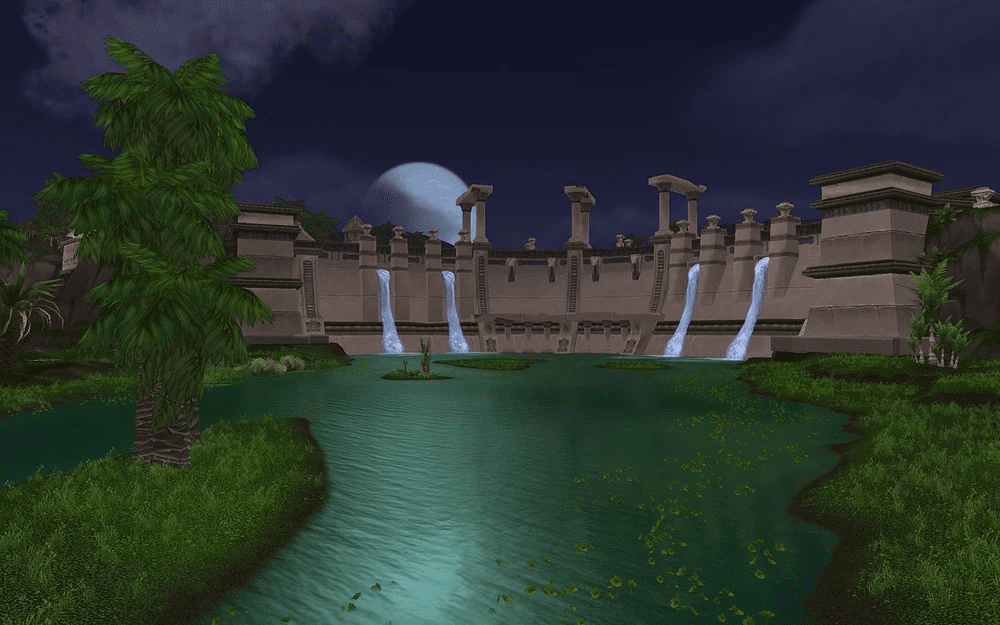
The changing of Uldum’s landscape from verdant sanctuary to desert expanse came not from natural decay, but from deliberate activation of the Forge itself. During the rise of Lei Shen the Thunder King, the region faced invasion by forces seeking to claim the Forge’s secrets. Unable to repel such power through conventional means, Uldum’s defenders chose preservation through the devastation of the land. The Forge was activated in a controlled surge, releasing waves of unmaking energy that destroyed the invading armies. But this act carried irreversible consequences alongside it. The same force that destroyed the threat reshaped the land, stripping away its lush ecosystems and leaving behind the barren desert that defines it today. What had once been fertile became enduringly harsh, a permanent reminder of the cost of safeguarding the world.
In the aftermath, Uldum was sealed away through a powerful illusion, hidden from the eyes of mortals for millennia. This concealment preserved not only its secrets, but also its isolation, allowing its guardians to maintain their watch undisturbed until the veil was finally broken at the time of the Cataclysm.
Geography of Purpose and Ruin
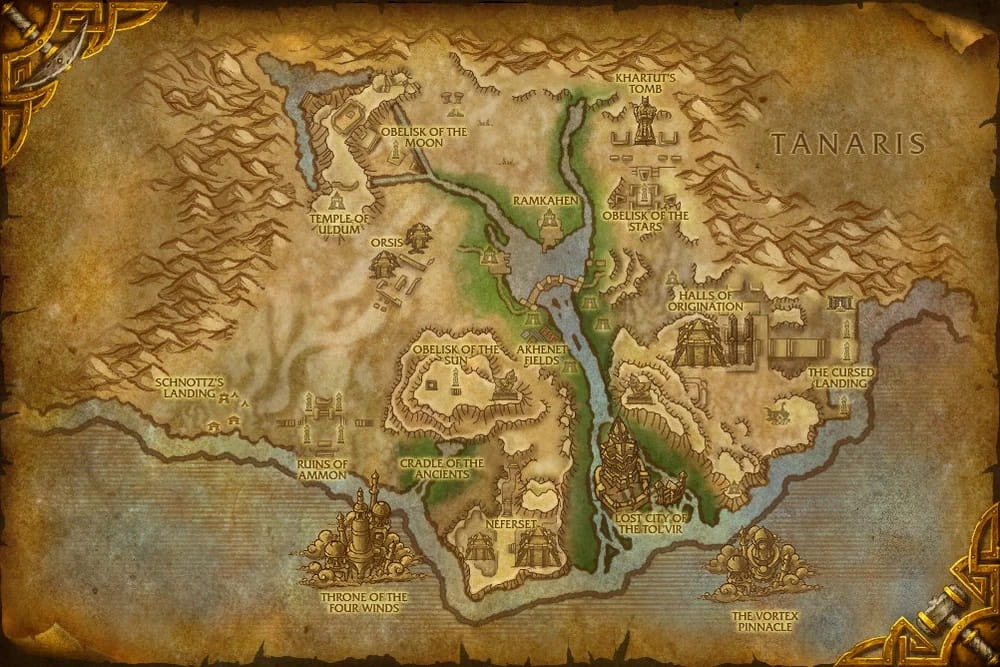
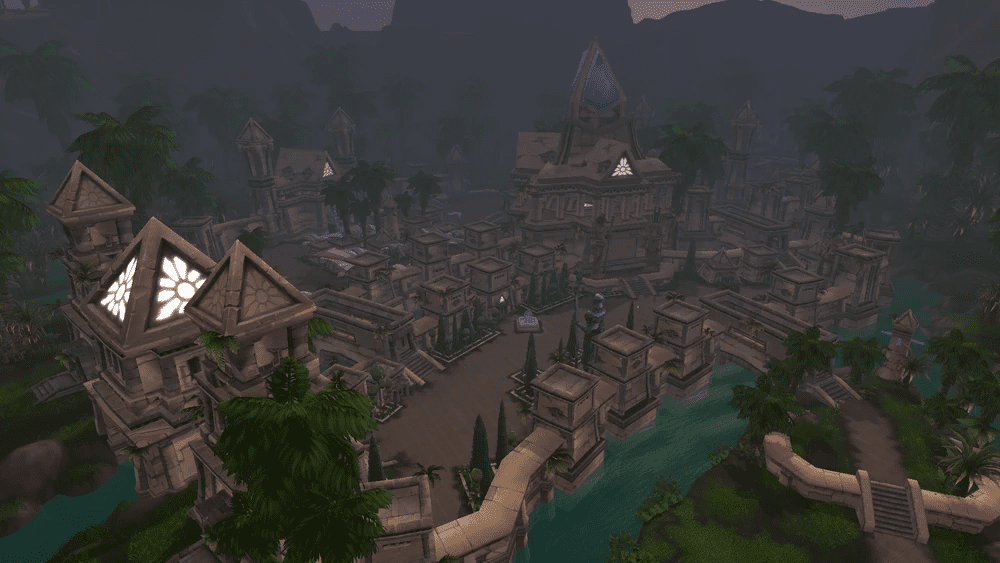
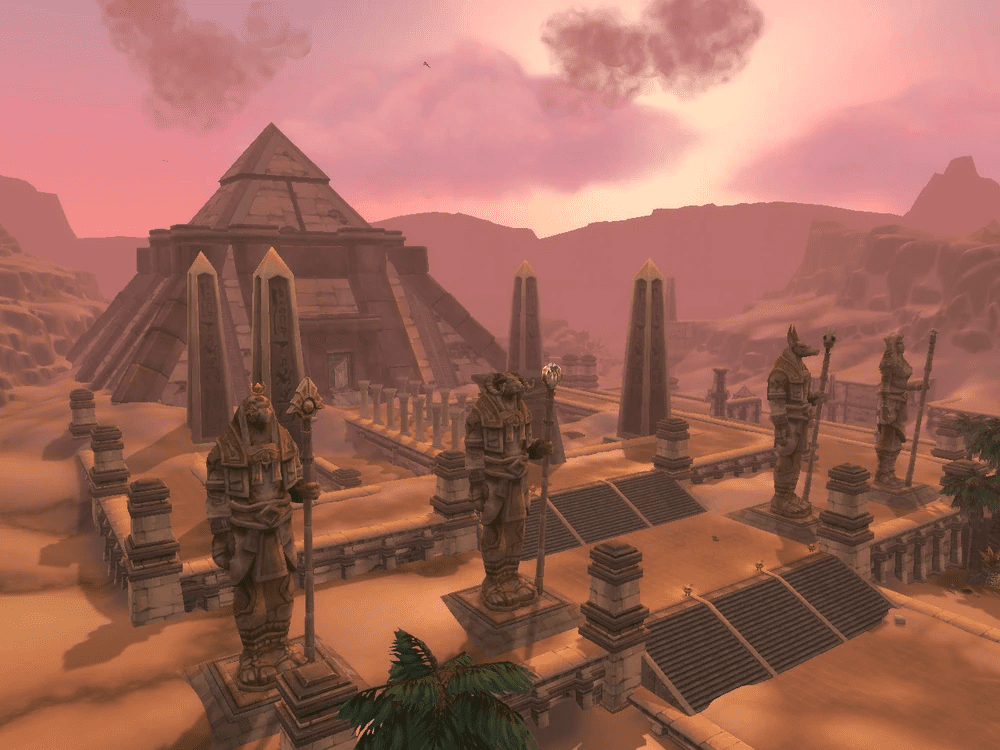
Modern Uldum presents a landscape shaped equally by design and destruction. Its central piece is a life-giving river, going through an oasis that sustains the primary settlements of the tol’vir, including the storied Lost City along its delta. Around this lifeline, civilization still persists. Beyond the river, the land stretches into vast dunes where half-buried ruins (pyramids and forgotten settlements) rise and fall with the shifting of the sands. These remnants point towards both the former grandeur of the region and the relentless forces that continue to reshape it. Elemental disturbances, particularly those tied to Al’Akir, have further scarred the terrain, scattering destruction across its western reaches.
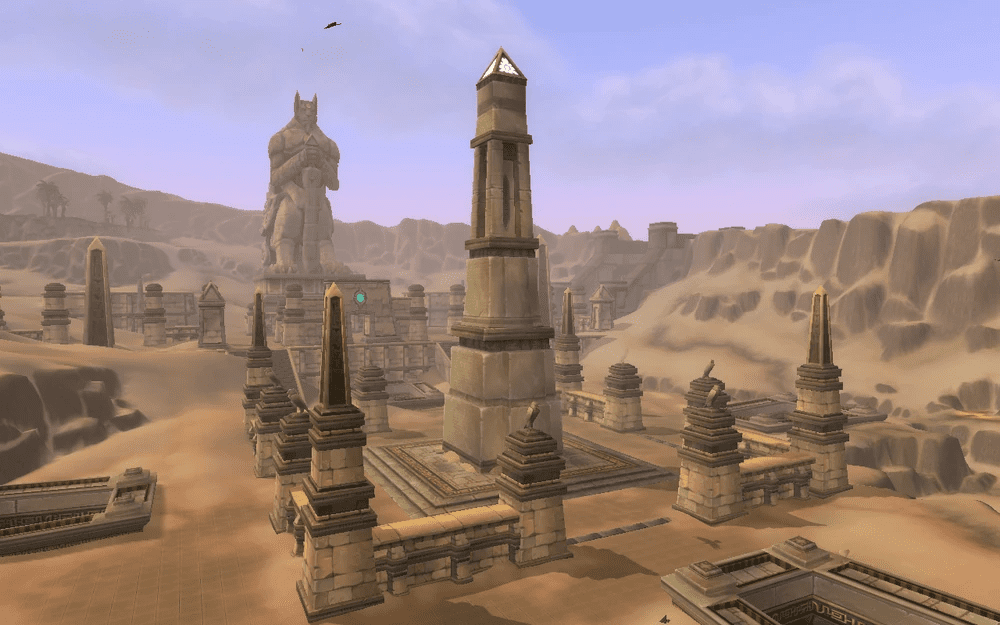
To the east stands the imposing structure of the Halls of Origination, a monumental pyramid housing the mechanisms tied to the Forge. In the northwest, constructs such as the Obelisk of the Stars and the Gate of Unending Cycles serve as both relics and thresholds, linking Uldum to neighboring lands like Tanaris. Along the southern cliffs, fortified settlements overlook the desert expanse, emphasizing defense above all else.
Custodians and Contenders of Uldum
The inhabitants of Uldum are as shaped by the land as the land is by its history. Chief among them are the tol’vir, whose existence is bound to their role as guardians of the titan legacy. Divided into factions such as the Ramkahen and the Neferset, their internal divisions reflect differing interpretations of duty, power, and survival.
External forces, however, have long sought to influence or fully claim Uldum. Explorers and relic-seekers from groups like the Explorers’ League and the Reliquary have established a presence at its borders, drawn by the promise of titan knowledge. At the same time, more destructive ambitions have emerged, particularly during the rise of Deathwing, whose influence extended even into Uldum through elemental proxies such as Al’Akir the Windlord.
The arrival of the Amathet tribe of tol’vir further complicated this balance. Emerging from newly unearthed tombs following the wound inflicted upon Azeroth by Sargeras (Legion expansion), they represent a rigid and uncompromising vision of stewardship. Their belief in exclusive dominion over titan relics has brought them into direct conflict with other tol’vir and defenders of the region, transforming Uldum into a contested ground where ideologies collide.
Personal Thoughts on Uldum
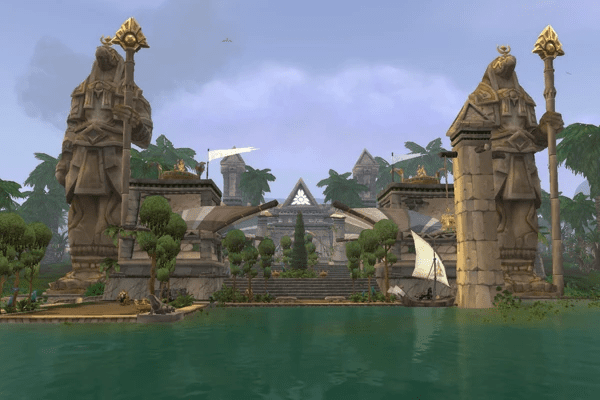
Uldum is a paradise, even with its “barren” form, compared to the other desert zones you transfer here from like Tanaris and Silithus. The moment you step into it, it’s just as the previous concealment of it indicated it to be, a hidden oasis. From its grander importance involving the titanic creations and titan-watchers, to the more simpler side of the tol’vir living there with their mission still intact, it invokes the feeling that this is a vacation place with some local problems on top. And it blends these two sides beautifully, never taking you out of the experience you’re getting into. One experience I can say from memory instantly is that my pockets are full of dusty remains because of all the times I wept standing in place, holding in my hands the crumbled remnants from a camel figurine to get that Grey Riding Camel. I’m starting to believe that the mount is simply a folk tale made to drive people into peak frustration.