
 World of Warcraft

To the opposite of Silithus but located on the same line lies Tanaris, a desert shaped as much by memory as by wind. Under its frying sun and across its rolling dunes lies a land that was not always barren, but transformed by catastrophe into a vast and unforgiving expanse. Today, the zone stands as a meeting point of ancient history and local enterprise, where remnants of primordial ages coexist with opportunistic settlements. Though its surface appears empty, the desert holds layers upon layers of significance (being geological, cultural, and temporal) each embedded within its sands and caverns.
Origins of a Shattered Landscape
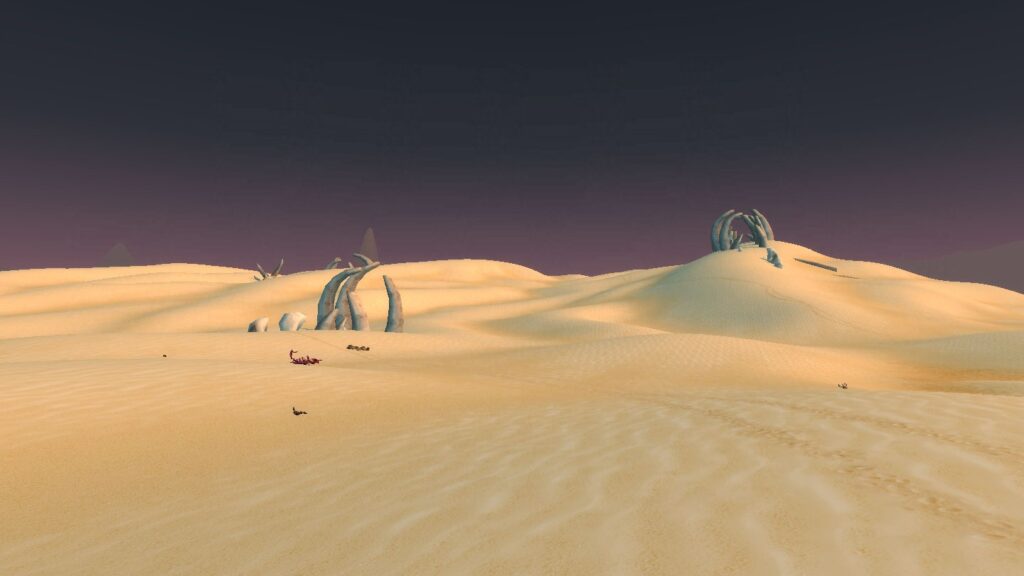
Tanaris was not always the desert we see today. In ages long past, it formed the part of a thriving jungle within the domain of the Gurubashi Empire. This fertile region was heavily altered during the Great Sundering, when the ancient continent fractured and reshaped the entirety of Azeroth. In the aftermath, lush vegetation changed into arid plains, and the newly formed Tanaris Desert emerged almost overnight. Stranded within this transformed land, trolls of the Farraki tribe adapted to the harsh environment over generations, evolving into the sand trolls who would come to define much of Tanaris’s early cultural identity. Their resilience mirrored the land in the way that they were unyielding and adaptive.
Geography of Tanaris
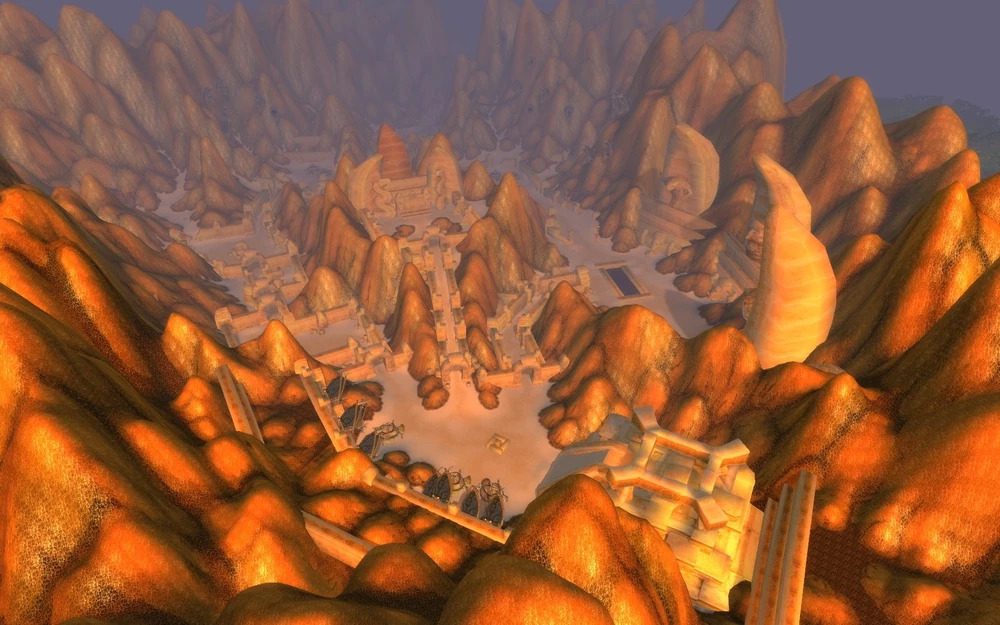
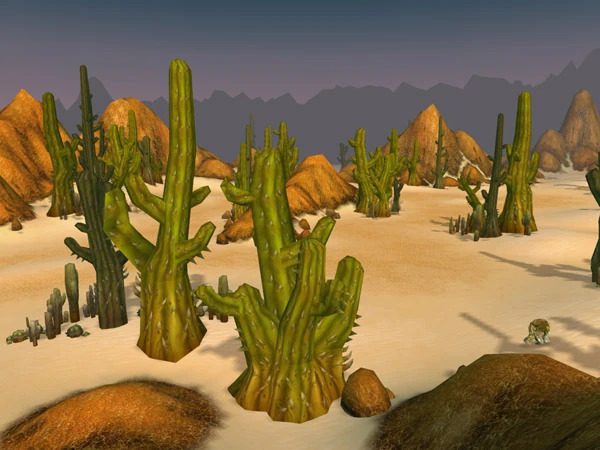
Tanaris spans a big portion of the southern side of Kalimdor, bordered by Thousand Needles to the north and Un’Goro Crater to the west. Its defining feature is an unbroken sea of dunes, where wind-carved ridges shift constantly beneath an open sky. The area is intensely hot, and sandstorms frequently travel across the land, reshaping its surface and obscuring what gets swept under it. However, beneath this simple monotony lies complexity. The southern reaches of the zone rise into mountainous terrain, filled with cavern systems that extend deep underground. These tunnels remain largely unexplored, their depths rumored to house dangerous creatures. The desert also supports an unexpected variety of life, from beasts easily adapted to this land such as scorpids and basilisks, to more hidden predators that thrive in its harsh conditions. Above the sands, drakes occasionally ride through the open sky, while below, vast tunnel networks hint at a hidden world that mirrors the scale of the desert itself.
Centers of Trade and Adaptation
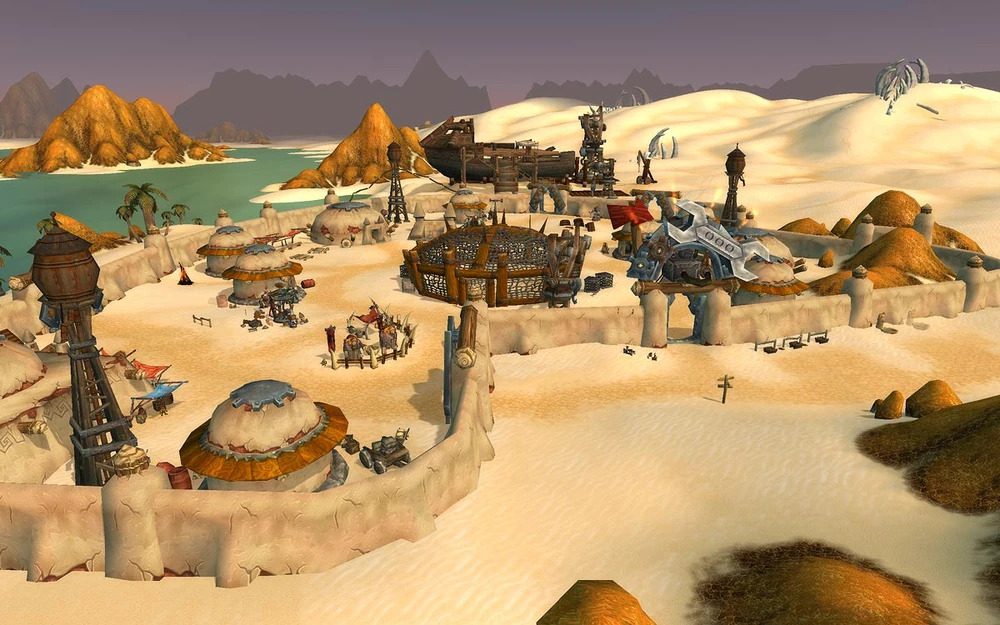
Despite its hostile environment, Tanaris has become a hub of activity, largely due to the presence of the Steamwheedle Cartel. The goblins established key settlements such as Gadgetzan and the Steamwheedle Port, transforming the desert into a center of commerce and opportunism.
Gadgetzan, once an inland outpost, underwent a dramatic transformation following the Cataclysm, when rising waters reshaped the coastline and brought it closer to the sea. This shift wildly increased its importance, allowing it to function as a port and further solidify goblin influence in the region. Meanwhile, the remnants of the Steamwheedle Port, partially destroyed and submerged, now stands as nothing more than a flooded space, occasionally housing quests for the daring adventurers.
Temporal Significance and Hidden Realms of Tanaris
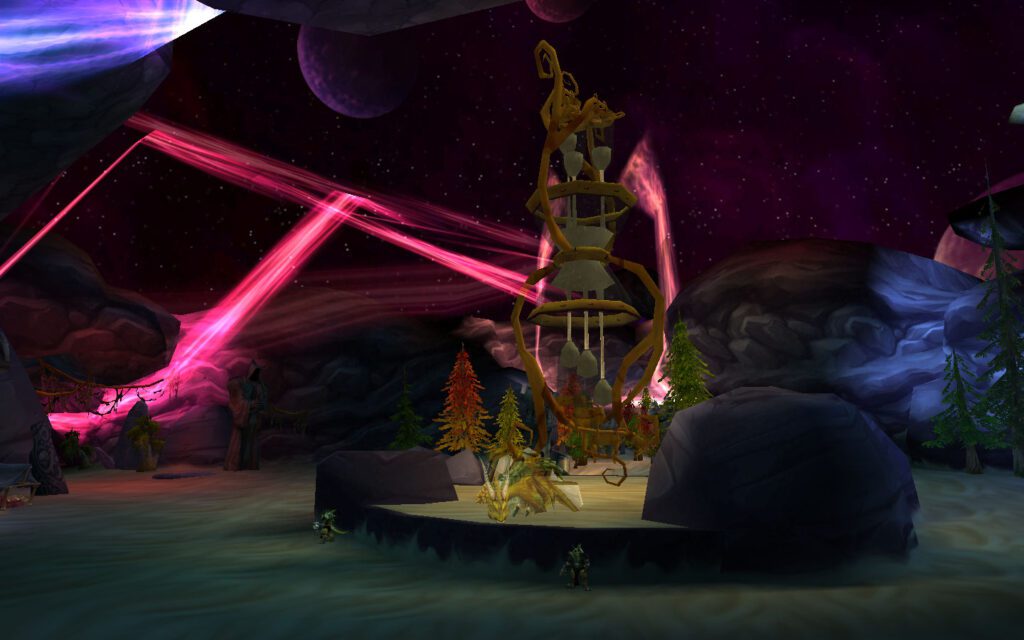
Apart from Gadgetzan, Tanaris holds a unique place within Azeroth due to its connection to time itself. Beneath its sands is the Caverns of Time, the domain of the bronze dragonflight. From this hidden sanctuary, these draconic guardians of time observe and protect the flow of history, anchoring Tanaris to events far beyond its physical limits. These events, most if not all being turning points for Azeroth, can also be witnessed by the players in the form of dungeons and raids. Nearby the caverns also lies the concealed entrance to Uldum, an ancient titan facility whose presence further shows the region’s importance. These factors position Tanaris not merely as a desert, but as a place of cosmic and historical forces.
The desert has also played a role in wider conflicts, serving as a staging ground or invasion point during major events. From incursions by the silithid forces to the movements of cults and armies, Tanaris has repeatedly been drawn into struggles that extend far beyond its borders.
Conflict, Cataclysm, and Continuity
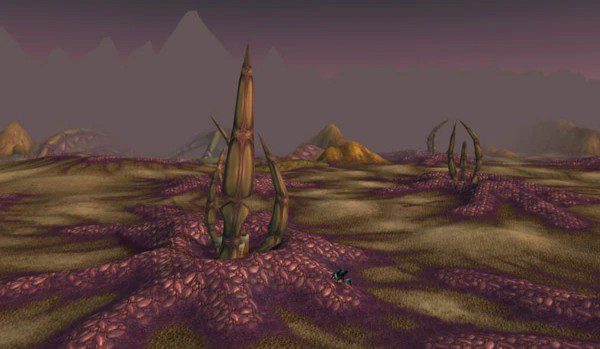
Throughout its history, Tanaris has endured repeated waves of conflict and disruption. It has seen invasions by the armies of C’Thun, as well as the Scourge before the Wrath of the Lich King. Each event has left an imprint, altering not only the land but its role within Azeroth. The Cataclysm marked one of the most significant turning points yet, reshaping coastlines and settlements. Later, during the Legion’s latest invasion, Tanaris once again became a battlefield, defended through coordinated efforts that prevented its complete devastation. Despite this terrible set of events, much of Tanaris remains unchanged in essence. Its settlements still hold ground, its dunes continue to shift, and its deeper mysteries remain largely undisturbed.
Personal Thoughts on Tanaris
Tanaris came to me as a shock the first time I visited it. Coming from the mostly barren zones north of it, that word was redefined for me, being that even the one called Barrens (the pun is in the name) was still housing some sort of local fauna and vegetation that could be considered a place worth living. Tanaris however, is just a desert at first glance. Hell, even that first glance is blinding as the sun reflects from the sand directly into your eyes. But it quickly grew on me as I reached the main hub area of Gadgetzan, and some more after running around the dunes that make up most of the zone. It had a strange calmness to it compared to the jungles of Feralas, for example. From the refreshing breaks you could take at Gadgetzan, to the “who pulled all the bugs” Zul’Farrak of the Sandfury trolls, from the Caverns of Time and its many portals to important events, to the road leading up to the gates of Uldum, Tanaris was a place that had a surprising amount of content in regards to being a “simple” desert.
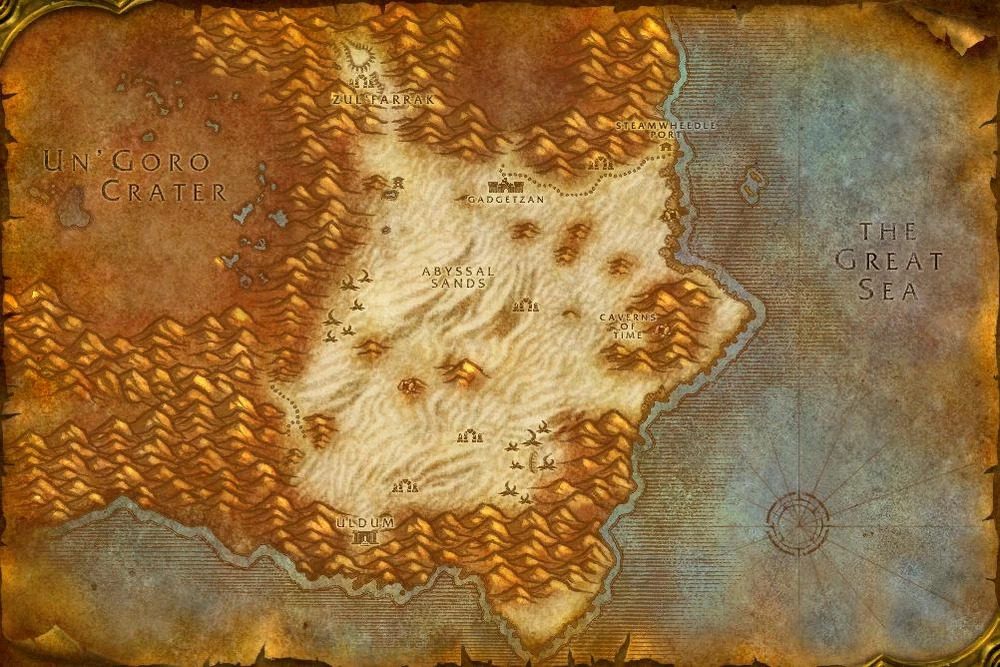
For more technical details and raw info, check Wowpedia. (Classic)
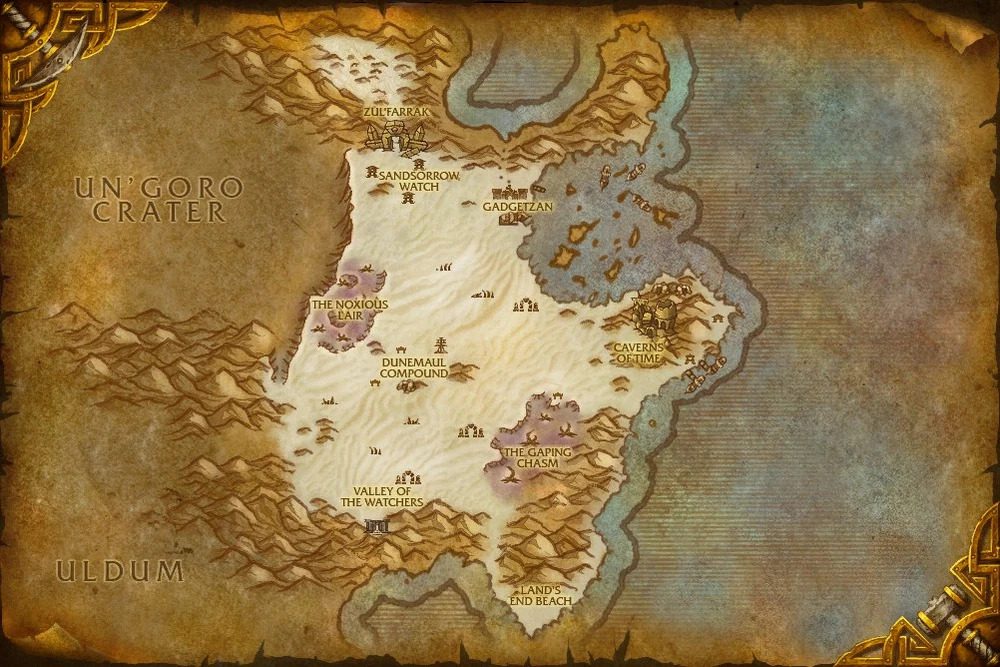
For more technical details and raw info, check Wowpedia. (Retail)