 World of Warcraft

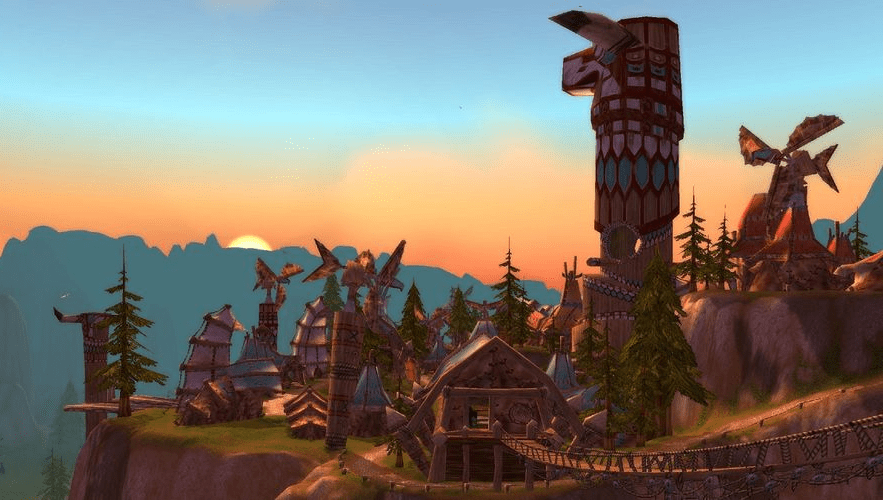
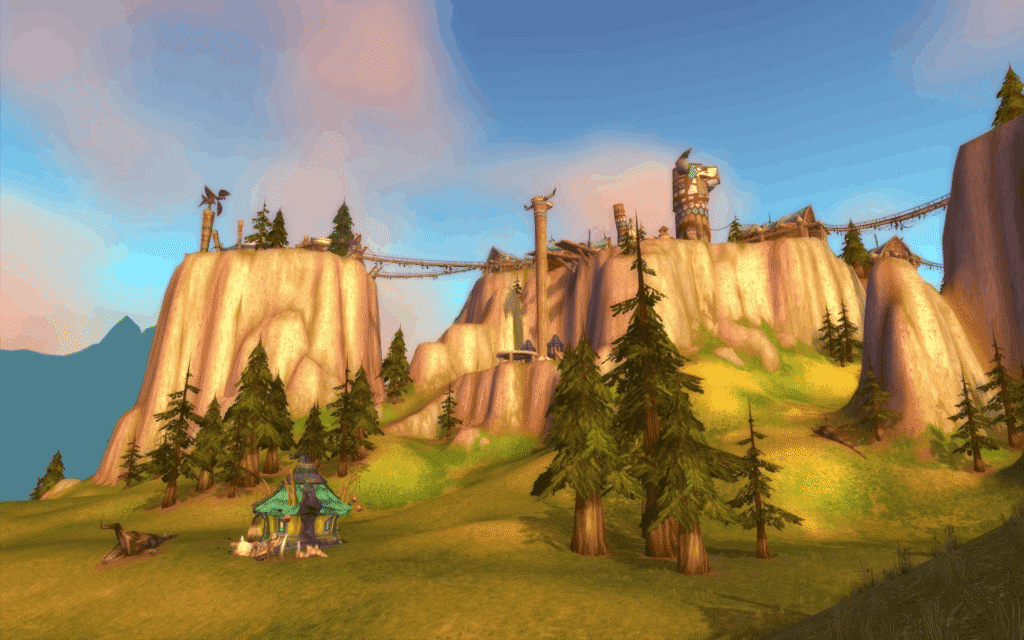
High above the evergreen grasslands of Mulgore, stands Thunder Bluff. Sat upon vast mesas carved by wind and time, the tauren capital city offers a vista that in my honest opinion, none of the other cities can offer. With the view of the Golden Plains below and its bridges of rope and timber stretching across deep chasms, linking districts, it offers a verticality that gives the feeling of safety to the visitor. More than a settlement, Thunder Bluff represents the turning point in the tauren’s history, the place where being a wanderer has ended and permanence began. From its founding in the wake of relentless centaur attacks to its survival through political unrest and cosmic threats, the city has endured as a testament to unity and resilience, qualities found similarly in its residents.
Foundations Upon the Wind-Carved Mesas
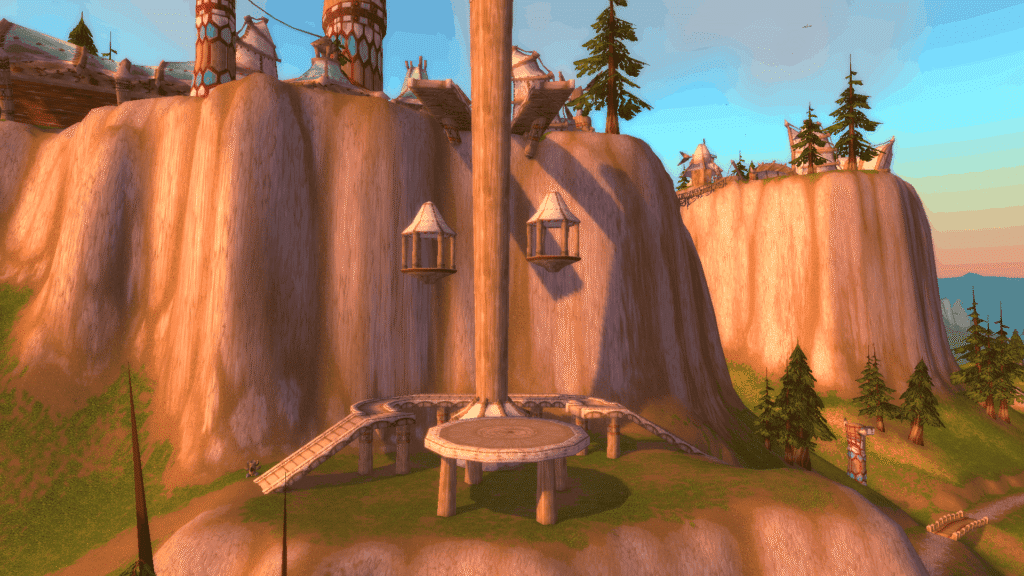
The city is located in northern Mulgore on the continent of Kalimdor just west of the Barrens, and offers connecting between the two areas, making Barrens the zone in which tauren players see their neighboring races for the first time. Built atop a series of towering mesas that rise several hundred feet above the plains, the city overlooks the verdant and nearly seemingly unending Golden Plains and the sweeping grasslands beyond. Its elevated position offers both protection and perspective, which can be accessed primarily by wooden elevators worked by pulleys (the pulleys are not really there in-game but how do they work otherwise?) on the southwestern and northeastern edges.
Established under the leadership of Cairne Bloodhoof following the Third War, Thunder Bluff marked the first permanent homeland for the tauren in centuries. Before its founding, the tauren tribes lived as nomads, roaming Kalimdor’s plains while enduring constant assaults from the centaur warbands. With the help of Warchief Thrall and the orcs, the centaur threat was driven back and Mulgore was claimed as sovereign land. Afterwards, the mesas became the foundation of a unified nation, with Thunder Bluff emerging not only as a capital, but as a declaration that the wandering era had ended.
Geography and the Rises
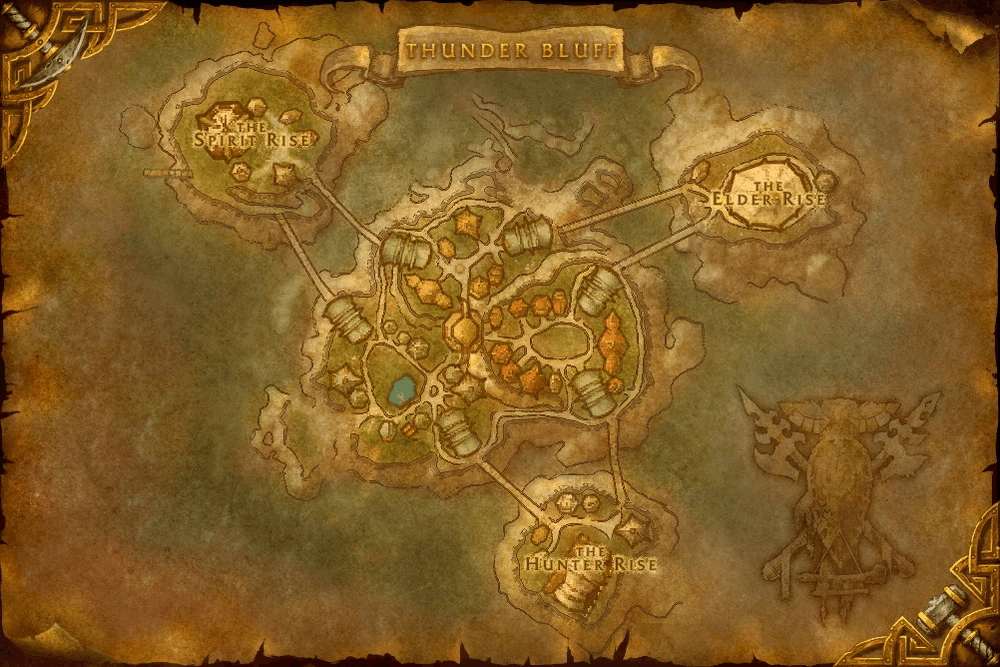
The city is structured across four primary mesas, each connected by expansive wooden bridges spanning deep ravines. The central mesa forms the heart of Thunder Bluff and is divided into three distinct rises: the Lower Rise, the Middle Rise, and the High Rise. Surrounding this core stand three additional mesas: Elder Rise, Hunter Rise, and Spirit Rise, each serving specialized communal functions.
The Lower Rise acts as the city’s primary hub of commerce and travel. Here’s located the inn, the auction house, the bank and the mailbox, and the wind rider roost. From its gigantic central totem tower, wind riders depart across Kalimdor, linking Thunder Bluff to distant Horde zones. A zeppelin dock west of Spirit Rise provides another travel option, showing the city’s role within the broader Horde network. The Middle Rise supports civic and administrative life, and houses the professional trainers for skinning, leatherworking, tailoring, enchanting, and alchemy. The High Rise on the other hand serves as the seat of tauren leadership via the High Chieftain’s quarters. Important decisions can also be watched in the open auditorium just outside of the quarters. This portion also has its share of trainers with cooking and fishing (best professions, no questions asked) trainers residing here.
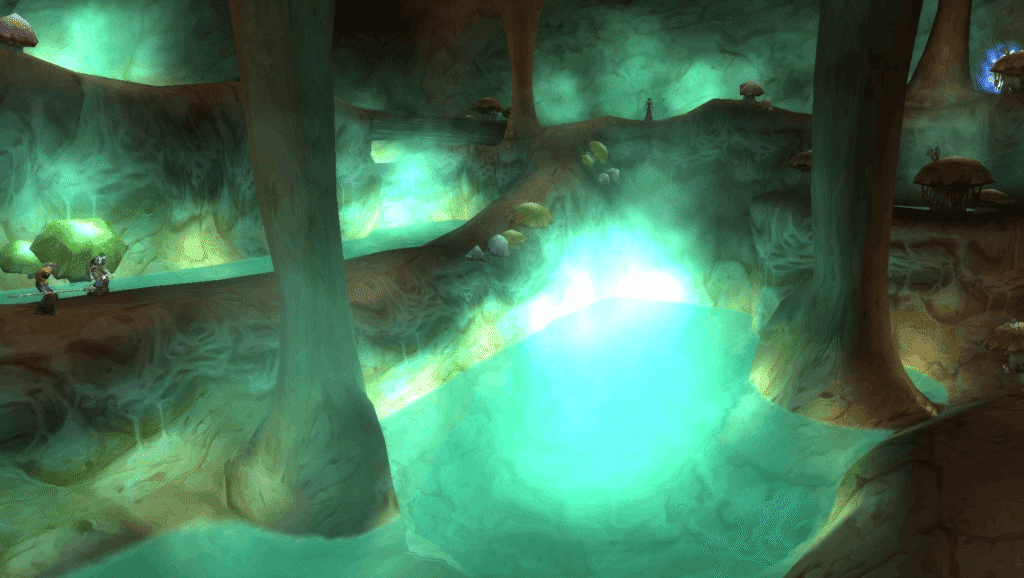
Elder Rise in the right corner of the city preserves spiritual traditions and ancestral reverence, sheltering the druid trainers. Hunter Rise, located just under the main rises supports the practical needs of those who defend and sustain the city through hunting and tracking, and houses class trainers for warriors, hunters, as well as a hunter pet trainer. Spirit Rise that sits at the north side of the city, contains the Pools of Vision, where communion with ancestral spirits and elemental forces continues to shape tauren philosophy. This part also has the trainers for mages, priests, and shamans, as well as a portal trainer for mages and a first-aid profession trainer.
Cultural and Political Significance
Thunder Bluff represents the unification of various tauren tribes under a single banner. Following its founding, tribes long scattered across Kalimdor gathered within its wooden lodges and painted tents. Totems adorned with tribal iconography stand throughout the city, affirming both individuality and collective identity.
As a capital within the Horde, Thunder Bluff welcomes allied races and travelers. Its artisans practice leatherworking, hunting, druidism, and shamanism, disciplines rooted in reverence for nature. The city’s openness to Horde visitors reflects its diplomatic role, yet its elevated and centralized geography has also made it strategically vulnerable. Its accessibility has, at times, allowed hostile forces to mount assaults upon its rises. Despite such threats, Thunder Bluff has maintained a reputation as a refuge. Hunters returning from the Barrens, spiritual leaders seeking counsel, and merchants traversing trade routes all converge here. The city’s layout (bridges linking specialized districts) mirrors the tauren ideal of balance between strength, wisdom, and harmony with the land.
Turmoil and Restoration
Thunder Bluff’s stability has not been without interruption. Following the death of Cairne Bloodhoof in a duel during the tumult preceding the Cataclysm, internal strife shook the city. Elements of the Grimtotem tribe seized control in a calculated coup, targeting key defenders and spiritual leaders across several rises. The assault disrupted the city’s equilibrium, particularly on Spirit and Hunter Rises, where losses were severe. This occupation lasted short, as loyalist forces reclaimed the mesas, restoring order and exiling those responsible. In the aftermath, leadership passed down to Baine Bloodhoof, who assumed the mantle of High Chieftain from the High Rise. The rebuilding process reinforced the city’s structural and spiritual foundations. The slain Skychaser tribe was succeeded by the Cloudsong tribe, ensuring continuity in shamanistic traditions.
Subsequent crises tested Thunder Bluff’s defenses further. During the Legion’s invasion, infernals rained upon the mesas, and the city’s image was later reflected in distorted form within the Emerald Nightmare, a vision of shattered rises suspended unnaturally. Yet these incursions did not permanently scar the physical city. Each time, restoration followed destruction.
Later conflicts during the Fourth War raised fears that Thunder Bluff might share the fate of other Horde capitals. Defensive reinforcements gathered along its bridges and rises, and the city endured without falling. Even assaults tied to shadowed forces from beyond Azeroth (Shadowlands) failed to claim it. Through political upheaval and external invasion alike, the mesas remained firmly in tauren control.
Thunder Bluff in the Greater World
Thunder Bluff occupies a unique position within Kalimdor and the Horde. Unlike the rough fortifications of Orgrimmar or the arcane spires of Silvermoon, Thunder Bluff’s strength lies in elevation, openness, and spiritual cohesion. Its architecture relies on timber, hide, and carved stone rather than towering battlements. The city’s defenses are subtle in the aspects of height, visibility, and unity.
Geographically central within Mulgore, Thunder Bluff anchors the region’s identity. It transforms the surrounding plains from contested hunting grounds into protected homeland. Caravans depart its rises, wind riders trace lines across the sky, and spiritual rites echo within its lodges. The mesas are both sanctuary and statement, visible proof that the tauren have claimed permanence without abandoning respect for the land.
Personal Thoughts on Thunder Bluff
Thunder Bluff may be one of the most calming places you can go to in Azeroth. Within the likes of Ironforge and Orgrimmar with their hand made and industrial looks, or Stormwind and Silvermoon with their eye-flashing bright colors, Thunder Bluff stands as a resting stop for the players’ poor eyes and lets them calm down after their whatever-nth failed drop of their favorite mount. Even now I remember creating tauren hunters one after another and taking the walk from the tauren starting area of Red Cloud Mesa to Thunder Bluff, just to do nothing and see the sprawling green land around and the towering city in the distance. It fills the viewer with great peace while slaughtering the local wildlife and quilboars.
The city itself stands as a giant column suspended between earth and sky, rooted in stone yet defined by wind. Its rises remain a showing of the tauren’s transition from nomadic struggle to sovereign stability. Though political storms and demonic invasions have tested its foundations, the mesas continue to hold firm above the plains of Mulgore.