
 World of Warcraft
Along the frozen margins of Azeroth’s northern seas, where ice groans like an ancient thing breathing in its sleep, an interesting race of walrus people have endured. Being a long demanded addition to the roster of playable races (it still sadly isn’t one), most players and outsiders in lore regarded them as simple fisherfolk with simple lives. However, recent expansions have revealed a far richer legacy, one entwined with ancient spirits, lost kin, and trials that tested their resolve across generations. From the shifting ice of Northrend to distant southern shores, the tuskarr have carried their traditions with them, adapting without surrendering who they are. This will be a recounting of their origins, ways, and endurance, told as one might pass a story beside a quiet fire, while the sea waits patiently beyond the ice.
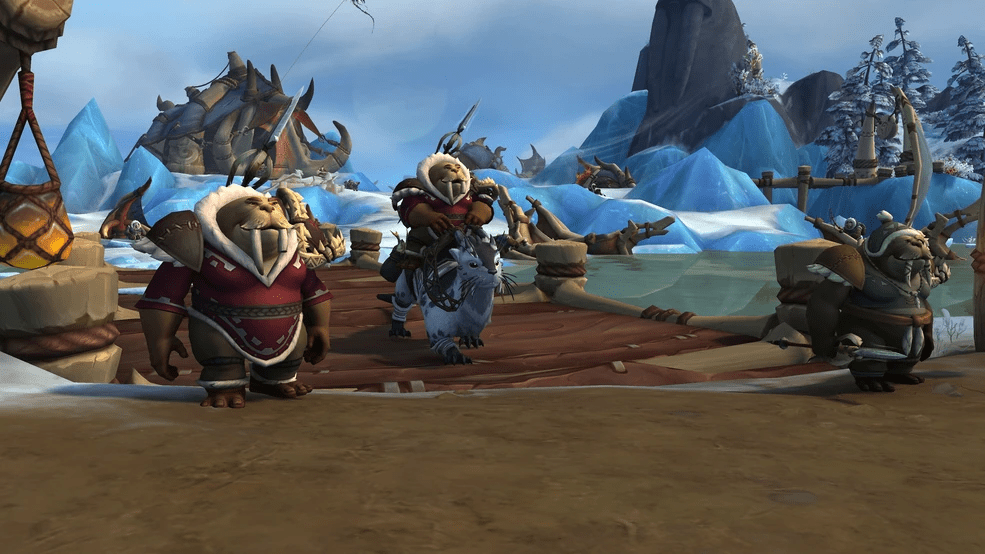
Origins Remembered Through Silence
The earliest chapters of tuskarr history remain unrecorded, preserved only in fragments of legend and the cautious theories of scholars. Among these, Brann Bronzebeard proposed that the tuskarr may descend from an Ancient Guardian shaped like the great walrus, a being whose strength and patience were inherited rather than taught. Whether truth or thoughtful speculation, the idea resonates with the tuskarr themselves, whose lives echo the endurance of stone and tide.
Long before the modern age, some tuskarr voyaged far from Northrend, settling upon the Dragon Isles. Though centuries passed and seas widened, their northern kin preserved tales of these lost relatives, carrying them like embers of memory through song and carving. Five centuries ago, such openness to the wider world was evident when Mina Stormsmith passed through Moa’ki Harbor. Her tales of battle and distant lands left a lasting impression, and the tuskarr, mistaking her earthen heritage, urged her toward the titans of Sholazar Basin. Even then, the tuskarr measured the world not by borders, but by shared spirit.
Bodies Shaped by Ice and Endurance
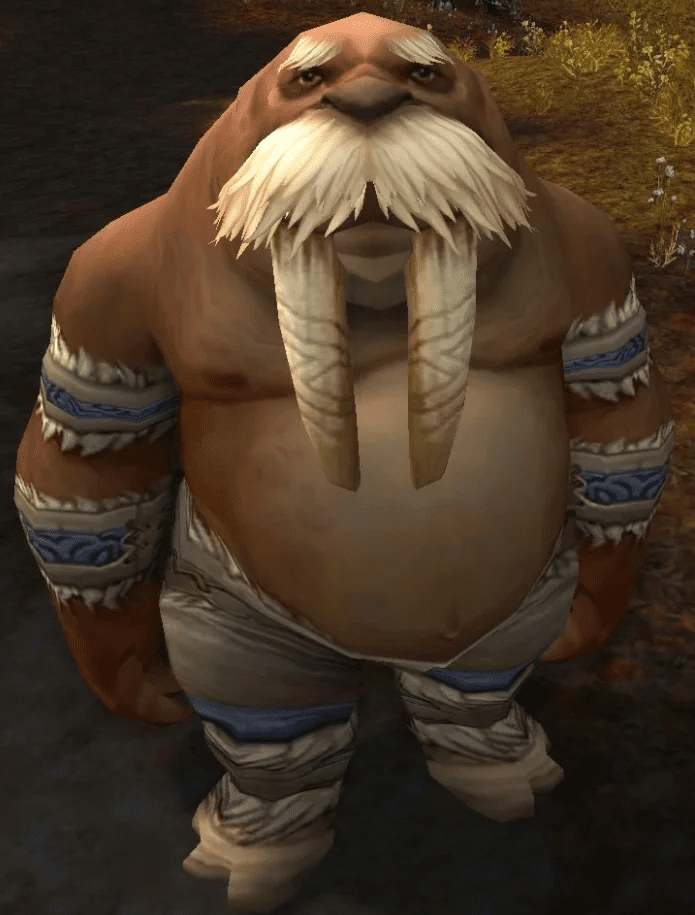
The tuskarr physique reflects the land and waters that raised them. Broad and sturdy, their bodies favor balance and resilience over speed (much like the dwarves). Cold, which brings about the end of many creatures swiftly, barely troubles them; even the freezing depths of Northrend’s seas cannot easily claim a Tuskarr’s life. Their tusks grow longer and deeper in color with age, bearing quiet testimony to years spent against wind and wave, though neglect can stain them just as time can.
Both males and females bear thick mustaches, often braided or adorned during ceremonies (I would also want to liken them to dwarves about this aspect, however Blizzard is just recently adding facial hair to dwarf women via the earthen dwarves playable race and not updating the already existing subraces, which frankly makes them cowards in my eyes). Their breath carries a distinctive sound, a long whistling sigh that escapes through pursed lips, a habit as unconscious as breathing itself. These traits are not seen as curiosities among the tuskarr, but as shared marks of kinship, reminders that survival is a collective inheritance rather than an individual triumph.
The Way of the Kalu’ak
Tuskarr society unfolds through clans, each a small constellation of families bound by shared routes and responsibilities. Along the southern coasts of Northrend, their migrations are guided by towering stone elders, carved statues that rise from shore and tundra alike. While many mark fishing routes along the coast, others stand far inland, suggesting paths older than memory. Among them, Pal’ea endures as the largest known stone elder, a silent witness over generations.
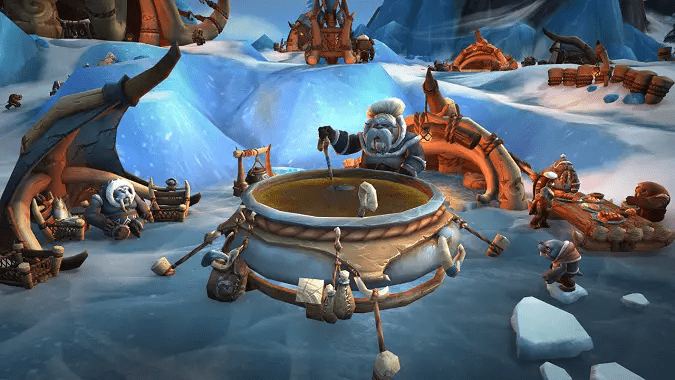
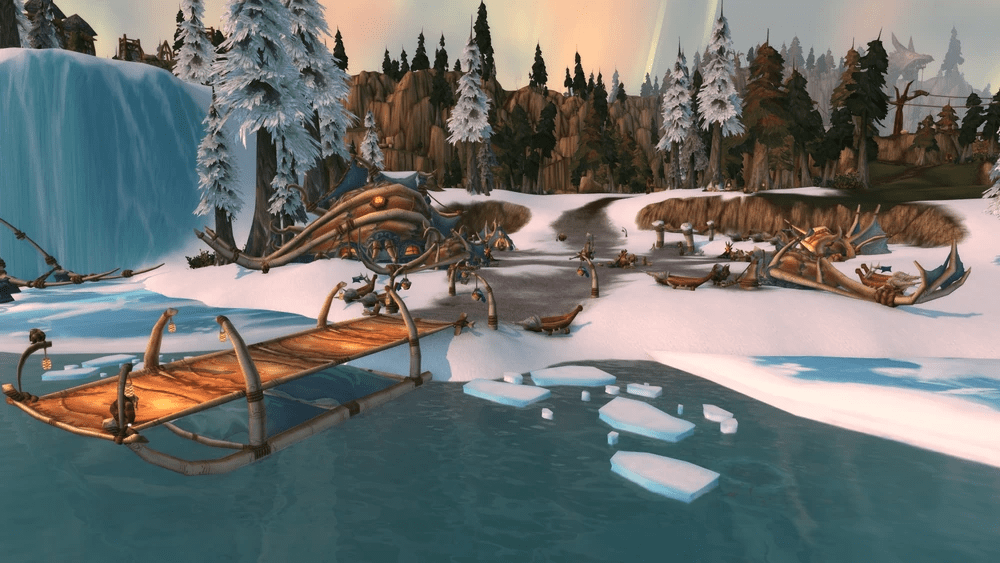
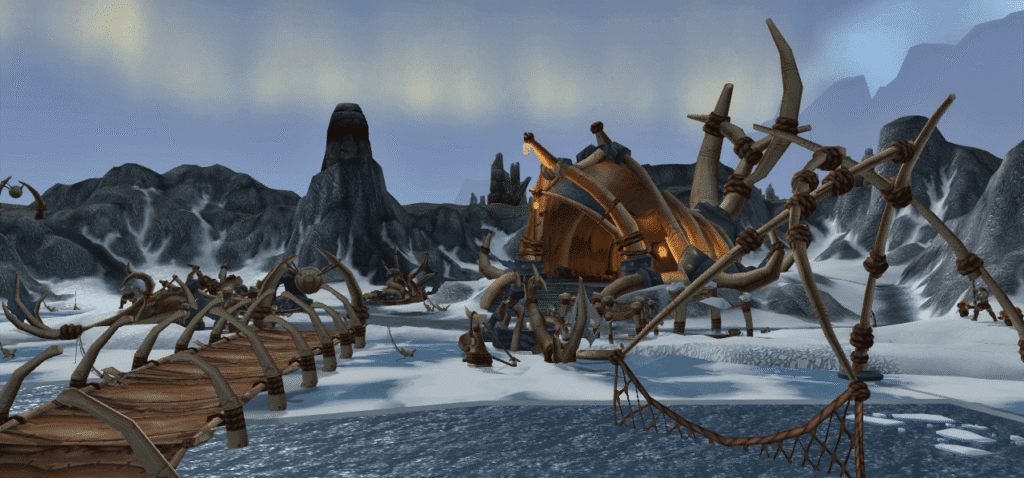
Daily life balances movement and permanence. Nomadic camps rely on oilskin tents, while settled villages rise from the bones of great sea beasts, dug deep into the earth for warmth and safety. Mothers and children often travel by sled across the ice, drawn by patient draft seals, while seasoned fishers take to the water, feeding the clan as they journey. Giant turtles serve as living vessels between distant shores, guided gently by simple lines and offerings of food.
Craft and identity intertwine through carved tusks, engraved with symbols of family or deeds worthy of remembrance. Names, too, are earned rather than inherited, bestowed for notable traits or accomplishments. Knowledge flows freely among them, for as traders and travelers, the tuskarr learned early that shared information can be as valuable as shared food.
Sea, Spirit, and Stone
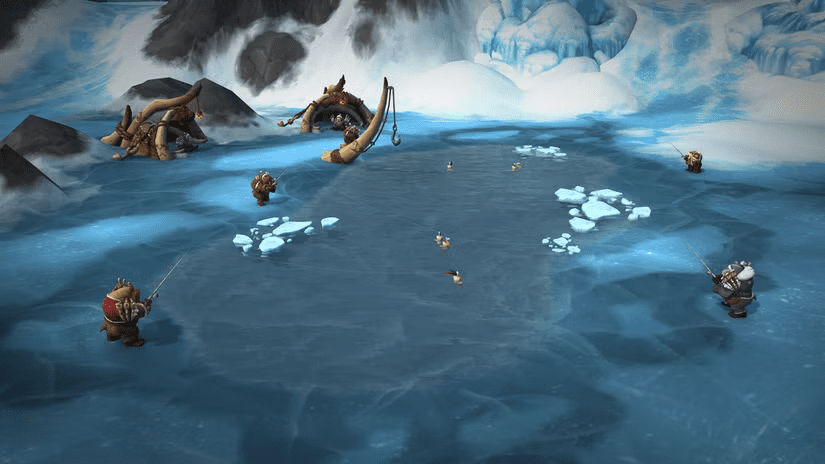
Fishing and whaling form the heart of tuskarr life, shaping both sustenance and social standing. From childhood, knowledge of the sea is passed privately between parent and child, reinforcing bonds as much as skill. Each clan appoints a catch master, who records daily hauls with knotted cords on a counting staff. Food is shared equally, yet surplus earns knots that may be exchanged for tools, luxuries, or trade beyond the clan.
Their mastery of the Frozen Sea is legendary. They hunt whales, giant squid, and creatures that even seasoned sailors fear, navigating ice floes without hesitation. Songs rise from their boats as nets are drawn, offered not only to one another, but to the ice itself.
Spiritually, the tuskarr walk a path closely aligned with shamanism, though its source remains distinct. They honor varied spirits depending on region, yet all acknowledge Karkut, guardian of the dead, who ensures departed souls do not lose their way. Stone elders house ancestral spirits, brought into living rock through careful ritual. At sites like Coldrock Quarry, the tuskarr carve these sacred forms and commune with those who came before, believing all souls are bound to the world’s magic. To imprison that magic, they fear, would unravel life itself.
An Age of Turmoil and Survival
The wars and upheavals of recent eras tested the tuskarr as never before. During the campaign against the Lich King, they welcomed Alliance and Horde allies, yet suffered grievously at the hands of others. The blue dragonflight’s assault on Coldrock Quarry annihilated an entire community for its stone, while an arcane catastrophe at Lake Indu’le left villages shattered and spirits restless.
Greed and ignorance brought further suffering when stolen vrykul artifacts awakened ancient evils. The return of the kvaldir proved devastating. Villages were razed, lives taken, and Kaskala (the tuskarr capital) fell amid fire and loss. Survivors fled east, carrying not only their belongings, but the weight of shattered stone elders and silenced ancestors.
Yet the tuskarr still endured. They wandered in the aftermath of the Cataclysm, appeared on distant islands, and followed new fishing grounds as the world changed. Some traveled south to Pandaria, others crossed seas to trade in Zandalar and Kul Tiras. Even in death, their spirits echoed in places like Helheim, bearing silent witness to battles long past.
Personal Thoughts on Tuskarr
The tuskarr remain a people defined not by bloody battles and clashing metals, but by continuity and survival. Their lives move with the rhythm of tides and seasons, shaped by patience learned from stone and resilience borrowed from the sea. Though history has struck them with loss and upheaval, it has never broken the thread that binds clan to clan, ancestor to child. Wherever their kites rise against the cold sky, they signal more than presence, they announce survival, community, and quiet celebration.
In a world often measured by power and dominion, the tuskarr offers a gentler legacy to be explored. They remind us that endurance doesn’t need to be loud, that wisdom can be found in simplicity, and that even amidst the harsh conditions of living, life can be lived with generosity. Their story continues not in the monuments of empires, but in steady journeys across frozen waters, guided by memory, spirit, and the enduring promise of home. And what do you know, maybe we also can find the strength in ourselves to still wait for them to be added as playable races.